Music & Culture | Jazz Heritage and Contemporary Interpretation
“Good Morning Heartache”: Four Voices, Eight Decades, and the Reinvention of an American Jazz Standard
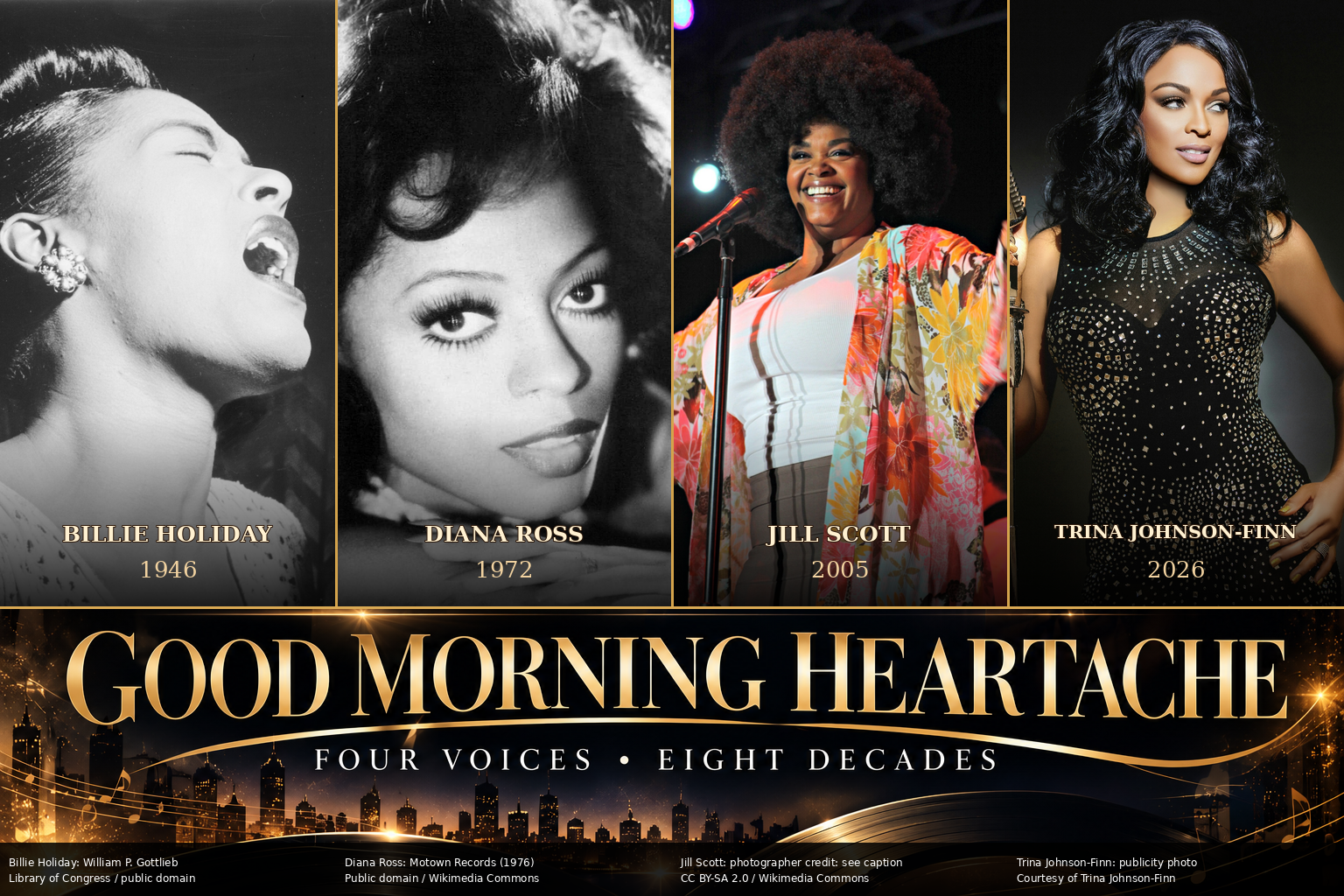
From Billie Holiday's intimate blues to Diana Ross's cinematic breakthrough, Jill Scott's theatrical soul, and Trina Johnson-Finn's contemporary jazz revival, one timeless composition continues to evolve.
Some songs become hits. Others become standards. A select few become part of the emotional vocabulary of American music.
“Good Morning Heartache” belongs to that final category.
First recorded by Billie Holiday in 1946, the composition by Irene Higginbotham, Ervin Drake, and Dan Fisher has traveled across generations, genres, and cultural boundaries without losing the emotional honesty that made it memorable.
The song's central premise is deceptively simple: heartbreak has become such a familiar presence that the singer greets it like an unwelcome companion each morning.
Yet within that premise lies remarkable interpretive freedom.
Over eight decades, artists have approached the composition through traditional jazz, cinematic storytelling, orchestral arrangements, neo-soul, and contemporary smooth jazz.
Four particularly revealing interpretations—those of Billie Holiday, Diana Ross, Jill Scott with Chris Botti, and Trina Johnson-Finn—demonstrate how a single song can take on different emotional identities while preserving its essential character.
Their recordings tell a larger story about the evolution of American vocal music and the continuing relevance of jazz standards.
Billie Holiday, 1946: The Voice That Defined Heartache
When Billie Holiday recorded “Good Morning Heartache” in 1946, she brought to the composition an interpretive sensibility that would help define its place in jazz history.
Holiday's artistry was never dependent on vocal extravagance.
Her power came from phrasing, emotional restraint, rhythmic freedom, and an extraordinary ability to communicate complex feelings through seemingly simple melodic choices.
She could make a lyric sound less like a performance than a personal confession.
In “Good Morning Heartache,” that approach transformed sorrow into something almost tangible.
Heartache was not presented as a dramatic event that had suddenly entered the singer's life. It was already there, waiting to be acknowledged.
The emotional effect was intimate and unsettling.
Holiday's phrasing often moved subtly around the underlying rhythm, creating an impression of reflection rather than resignation. She allowed the spaces between phrases to communicate as much as the words themselves.
This was one of her defining artistic gifts: the ability to make listeners feel that they were witnessing a private emotional moment.
Her recording established the song's interpretive foundation.
Subsequent artists could change the tempo, arrangement, instrumentation, and performance style, but they would still confront the emotional world Holiday helped establish.
That legacy created both an opportunity and a challenge.
How could another vocalist honor such an iconic interpretation while discovering something genuinely personal within the same composition?
For Diana Ross, the answer would emerge through one of Hollywood's most celebrated musical biographies.
Diana Ross, 1972: When Jazz Heartache Reached Hollywood
More than a quarter-century after Holiday's original recording, Diana Ross introduced “Good Morning Heartache” to a new generation through the 1972 motion picture Lady Sings the Blues.
The film marked Ross's dramatic screen debut and presented her portrayal of Billie Holiday to a mainstream moviegoing audience.
It also created a distinctive artistic challenge.
Ross was not simply recording a jazz standard. She was interpreting music associated with the real-life artist she portrayed on screen.
That required navigating the delicate boundary between historical representation and personal expression.
Ross approached Holiday's repertoire with evident respect for the original recordings, while bringing her own vocal character and musical instincts to the material.
Her version of “Good Morning Heartache” retained the song's melancholy atmosphere but presented it within a polished cinematic and popular-music framework.
Where Holiday's recording suggested an intimate encounter with sorrow, Ross's performance carried the additional emotional weight of a dramatic narrative.
The listener was hearing both a song and a musical expression associated with the life of the character portrayed on screen.
The distinction mattered.
Through Lady Sings the Blues, Holiday's musical legacy reached audiences who might not otherwise have encountered her original recordings.
Ross's performance also demonstrated that classic jazz material could connect with contemporary popular-music listeners without abandoning its historical identity.
The film earned Ross an Academy Award nomination for Best Actress, while its soundtrack became a major commercial success.
“Good Morning Heartache” itself entered the popular singles market, extending the composition's reach beyond its established jazz audience.
Ross's interpretation therefore occupies an important place in the song's cultural journey.
She helped move the standard from the intimate world of mid-century jazz into a broader conversation involving cinema, popular culture, and the enduring influence of Black women in American music.
Her contribution was not simply to reproduce Holiday's emotional language.
It was to introduce that language to another generation.
And as popular music continued to evolve, the song would find yet another expressive identity.
Jill Scott and Chris Botti, 2005: Heartache Becomes a Conversation
By the early twenty-first century, jazz standards were increasingly being revisited by artists whose musical backgrounds extended well beyond traditional jazz.
Neo-soul, contemporary R&B, spoken word, and crossover jazz offered new possibilities for interpreting familiar compositions.
Jill Scott's collaboration with acclaimed trumpeter Chris Botti on “Good Morning Heartache,” featured on Botti's 2005 album To Love Again, illustrates that evolution.
Scott brought a distinctive artistic vocabulary to the song.
Her performances combine the emotional directness of soul music with the flexibility of jazz phrasing and the storytelling instincts of a spoken-word artist.
Rather than treating the composition as a fixed emotional statement, Scott approaches it as a conversation that can develop and change during the performance.
Her vocal expression moves between melodic interpretation and theatrical communication, allowing the emotional narrative to become unusually immediate.
In live performances, that approach becomes especially apparent.
Scott can address heartache almost as though it were another person in the room, introducing humor, frustration, defiance, and vulnerability into the experience.
This creates a different relationship between singer and audience.
The listener is no longer simply observing someone living with sorrow.
The listener becomes part of an unfolding emotional encounter.
Chris Botti's trumpet adds another expressive dimension.
Its lyrical tone provides a complementary musical voice, extending the emotional atmosphere beyond the sung text.
The interaction between vocalist and instrumentalist becomes an important part of the interpretation.
Where Billie Holiday communicated heartache through understatement, and Diana Ross presented it within a cinematic narrative, Scott explores its theatrical and conversational possibilities.
Her approach reflects a broader development in American vocal music: the merging of jazz tradition with contemporary soul expression.
Yet the song's journey did not end with these interpretations.
In 2026, another vocalist would approach “Good Morning Heartache” from a different musical direction, emphasizing not only the experience of sorrow but also the possibility of moving through it.
Trina Johnson-Finn, 2026: A Contemporary Rhythm for an Enduring Emotion
For contemporary jazz vocalist and recording artist Trina Johnson-Finn, “Good Morning Heartache” offers an opportunity to connect a celebrated American standard with the musical language of today's smooth jazz audience.
Released July 4, 2026, her recording reimagines the composition through contemporary production, a more rhythmically active arrangement, and a vocal approach informed by jazz, soul, and theatrical performance.
The artistic distinction lies in the relationship between the song's emotional content and its musical setting.
Traditional interpretations frequently emphasize melancholy through restrained tempos, spacious instrumentation, and reflective phrasing.
Johnson-Finn's recording introduces a different sense of movement.
The arrangement's contemporary groove creates rhythmic momentum beneath lyrics that continue to acknowledge the persistence of emotional pain.
This contrast invites a fresh interpretation of the composition.
Heartache remains present, but the music does not remain emotionally stationary.
Instead, the arrangement suggests the possibility of resilience.
It is a subtle but meaningful shift in perspective.
The song does not deny sorrow or attempt to transform a lament into uncomplicated celebration.
Rather, it places familiar emotions within a musical environment that suggests life continues beyond disappointment.
Johnson-Finn's professional background provides context for this approach.
With musical roots connected to Kansas City's jazz tradition and extensive experience in Las Vegas entertainment and international performance settings, she brings together influences from classic jazz, contemporary soul, and theatrical presentation.
Her artistry reflects an understanding that vocal interpretation involves more than accurately delivering a melody.
It requires finding a personal relationship with the emotional narrative.
In “Good Morning Heartache,” that relationship emerges through the contrast between the familiar lyric and the recording's contemporary rhythmic character.
The result is a reinterpretation designed to connect with listeners who appreciate the history of vocal jazz while embracing the polished production and groove-oriented arrangements associated with contemporary smooth jazz.
Rather than attempting to recreate Holiday's intimate blues, Ross's cinematic presentation, or Scott's theatrical dialogue, Johnson-Finn explores another possibility.
What if heartache can be acknowledged without surrendering one's forward momentum?
That question gives her recording a distinctive place within the song's continuing interpretive history.
A Classic Standard Finds New Life on Contemporary Jazz Radio
Artistic reinterpretation is one achievement. Reaching a contemporary audience is another.
For independent recording artists, the challenge is especially significant.
Today's jazz marketplace spans terrestrial radio, international internet stations, streaming platforms, specialty programming, and curated playlists.
A recognizable composition may provide an initial point of familiarity, but the recording itself must establish a compelling musical identity.
Johnson-Finn's release has demonstrated encouraging early results within the contemporary jazz radio environment.
Following its July 2026 debut, “Good Morning Heartache” entered the SmoothJazz.com Global Top 100 Airplay chart at No. 92 and climbed to No. 73 as well as reaching No. 7 on the Weekend Radio Station Top 30 Chart in Spain.
Radio-monitoring reports have also documented exposure across multiple international markets, reflecting the recording's developing reach beyond its initial domestic audience.
These results should be understood within the context of an independent release campaign rather than as direct comparisons with the commercial histories of Holiday, Ross, or Scott.
The significance is not that Johnson-Finn's recording has displaced earlier interpretations.
It is that a composition introduced nearly eighty years earlier continues to find relevance within modern jazz programming.
That relevance speaks to the adaptability of the song itself.
For some listeners, Johnson-Finn's recording may offer a contemporary perspective on a familiar standard.
For others, it may become their first introduction to “Good Morning Heartache,” encouraging them to discover the artists and musical traditions that preceded it.
Both possibilities help sustain the cultural life of jazz.
Four Voices, Four Musical Perspectives
Although these interpretations span different eras, they should not be understood as a direct progression in which one artist necessarily influenced the next.
Each recording emerged from its own musical environment, artistic priorities, and audience expectations.
Together, however, they reveal four compelling ways of approaching the same emotional material.
Billie Holiday: The Recognition
Holiday made heartache feel like an intimate companion. Her restrained delivery established the emotional foundation through which generations of listeners would understand the composition.
Diana Ross: The Transformation
Ross carried the song into cinema and mainstream popular culture, helping introduce Holiday's repertoire to audiences beyond the traditional jazz marketplace.
Jill Scott: The Confrontation
Scott expanded the song's emotional vocabulary through theatrical storytelling, contemporary soul, and conversational interaction, supported by Chris Botti's expressive trumpet.
Trina Johnson-Finn: The Renewal
Johnson-Finn places the familiar lament within a contemporary rhythmic setting, suggesting that emotional vulnerability and forward movement can coexist.
These differences are not measures of artistic superiority.
They are examples of interpretive freedom.
And that freedom is one of the essential characteristics of jazz.
Why the Reinvention of Jazz Standards Still Matters
The continued relevance of “Good Morning Heartache” raises a larger question about the preservation of American musical heritage.
Should classic compositions remain closely associated with their original interpretations, or should contemporary artists continue reshaping them for new audiences?
Jazz history suggests that these goals are not mutually exclusive.
Standards have endured precisely because musicians have repeatedly discovered new possibilities within familiar material.
A melody can remain recognizable while its arrangement changes.
A lyric can retain its original meaning while a performer introduces a different emotional perspective.
An audience can appreciate the historical significance of a recording while embracing an interpretation that reflects its own musical preferences.
This is especially important for younger listeners who may encounter jazz through contemporary R&B, smooth jazz, film soundtracks, or digital playlists rather than traditional jazz recordings.
A new interpretation can become a doorway into an older musical tradition.
For independent artists such as Johnson-Finn, this creates an opportunity to contribute to jazz's continuing evolution while honoring its historical foundations.
Her 2026 recording represents one example of how that relationship can work.
The familiar composition remains intact.
Its emotional possibilities continue to expand.
And the audience is invited to hear a classic song from another perspective.
Eight Decades Later, Heartache Still Has Something to Say
Nearly eighty years after Billie Holiday first recorded “Good Morning Heartache,” the composition continues to resonate because its central emotional experience remains universal.
Loss, disappointment, memory, and resilience are not confined to a particular generation or musical style.
What changes is the way artists choose to express them.
Holiday gave heartache an intimate voice.
Ross brought that voice into a new cultural spotlight.
Scott turned heartache into an expressive conversation.
Johnson-Finn introduced a contemporary rhythmic perspective that suggests movement beyond sorrow.
Four distinctive artists, separated by decades of musical change, have found different ways to communicate the emotional truth of one enduring composition.
That is the remarkable legacy of “Good Morning Heartache.”
Its power does not depend on remaining unchanged.
It endures because each new generation can discover something of itself within the music.
And perhaps that is the most meaningful quality of a great jazz standard.
It remembers where it came from while leaving room for the next voice to tell the story.
About Trina Johnson-Finn
Trina Johnson-Finn is a contemporary jazz vocalist, recording artist, and international performer whose musical background draws upon jazz, soul, and theatrical performance traditions.
With roots in Kansas City's jazz heritage and professional experience in Las Vegas and international entertainment markets, she brings a distinctive interpretive perspective to classic and contemporary material.
Her July 2026 release of “Good Morning Heartache” reimagines the celebrated American standard through contemporary jazz production and a rhythmically engaging arrangement.
LISTEN AND DISCOVER
Hear Trina's interpretation.
Photographic credits
- Billie Holiday: William P. Gottlieb, circa February 1947. Library of Congress; public domain. Source photograph.
- Diana Ross: Motown Records, 1976; public domain. Source photograph.
- Jill Scott: Alphonse Photography, Jazz in the Gardens, March 17, 2012. Source photograph via Wikimedia Commons, CC BY-SA 2.0. Cropped and placed within the supplied collage with text and graphic overlays; the adapted Jill Scott panel is shared under the same license.
- Trina Johnson-Finn: Publicity photograph courtesy of Trina Johnson-Finn.


The supplied photographic collage is displayed without further image alteration.
Editorial feature prepared for Lipstick Diva Entertainment Group LLC.